“`html

English:to teach
English:explanation
English:bright
English:to know
English:teacher’s explanation
English:to look at the textbook
English:I listen to the teacher’s explanation.
English:Please teach me one more time.
English:Do you know this kanji?
English:The teacher explains N4 kanji. The student listens while looking at the notebook. When the student does not understand, they ask one more time.
English:character / letter
English:sentence
English:text / passage
English:to copy
English:study
English:practice
English:I write characters in my notebook.
English:I copy this sentence.
English:I practice kanji every day.
English:The student writes characters in the notebook. The student copies the teacher’s sentence. The student writes kanji many times and practices.
English:question / problem
English:answer
English:to answer
English:to think
English:to think / feel
English:correct answer
English:I read the question carefully.
English:I think about the answer.
English:I choose the correct answer.
English:The student reads the question. The student does not know the answer right away. The student reads it again and thinks slowly.
English:test / exam
English:to try
English:to begin
English:to finish
English:research / study
English:to study
English:I study before the test.
English:The test starts at 9.
English:The test finishes at 11.
English:Tomorrow is the test. I study kanji and grammar. The test starts at 9 and finishes at 11.
“`
N4で覚えたい
場面ごとに学ぶ 学校・勉強・試験の漢字
場面ごとに学ぶ 学校・勉強・試験の漢字
School, Study & Test Kanji
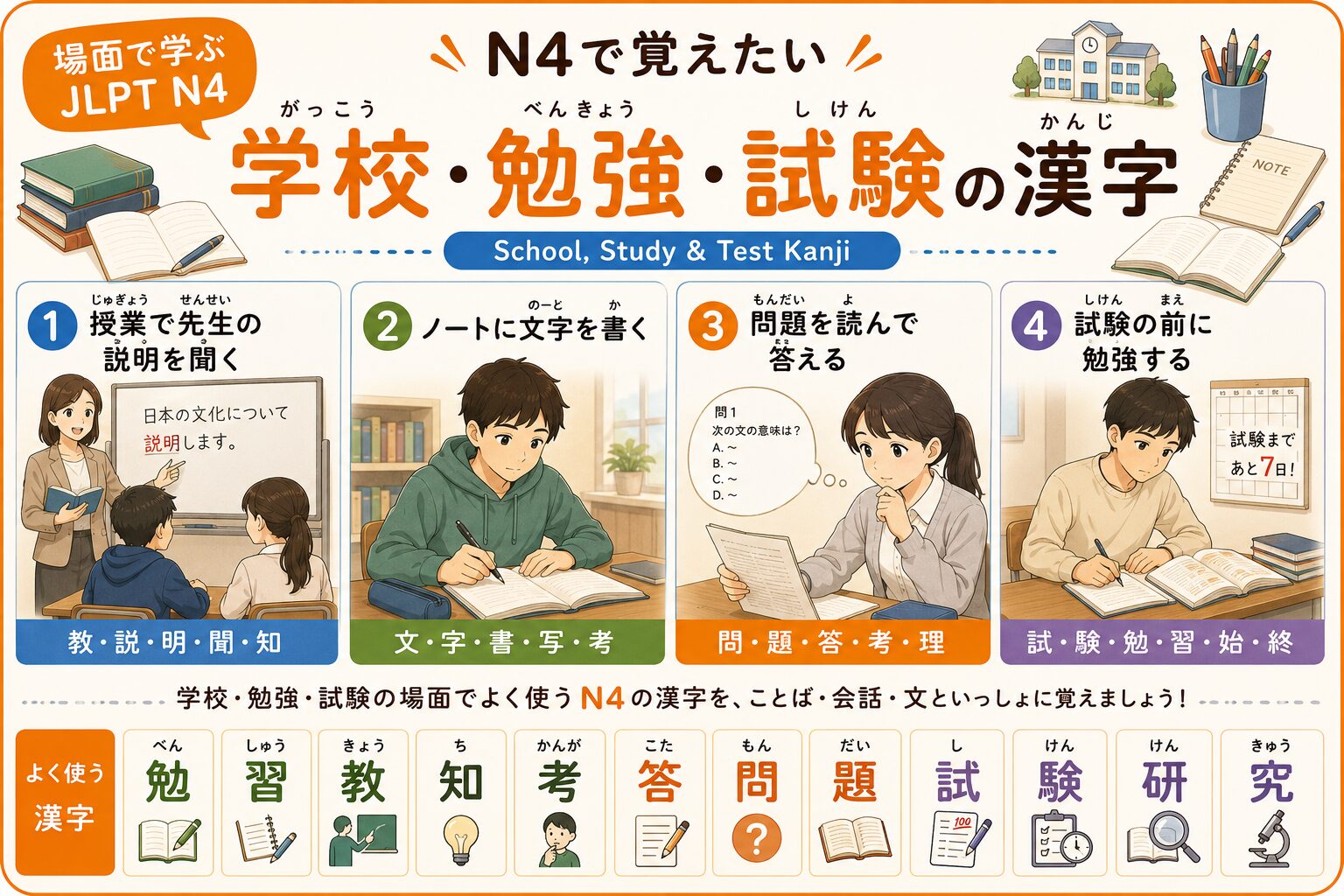
この記事では、学校・勉強・試験で使うN4の漢字を、場面ごとに勉強します。
漢字だけを覚えるのではなく、授業・ノート・問題・試験 の中で使うことばといっしょに覚えます。
日本語がまだ上手ではなくても大丈夫です。短い文で、少しずつ練習しましょう。
今日のポイント:
「授業で先生の説明を聞く」「ノートに文字を書く」「問題を読んで答える」「試験の前に勉強する」の4つの場面で、学校・勉強・試験の漢字を覚えます。
「授業で先生の説明を聞く」「ノートに文字を書く」「問題を読んで答える」「試験の前に勉強する」の4つの場面で、学校・勉強・試験の漢字を覚えます。
場面をえらんで勉強しよう
画像をクリックすると、その場面へ移動します。
今回出てくるN4漢字
この漢字を、4つの場面の中で使いながら覚えます。
勉
べん
習
しゅう
教
おしえる
知
しる
考
かんがえる
答
こたえる
問
もん
題
だい
試
し
験
けん
研
けん
究
きゅう
文
ぶん
字
じ
説
せつ
明
めい
写
うつす
思
おもう
始
はじまる
終
おわる
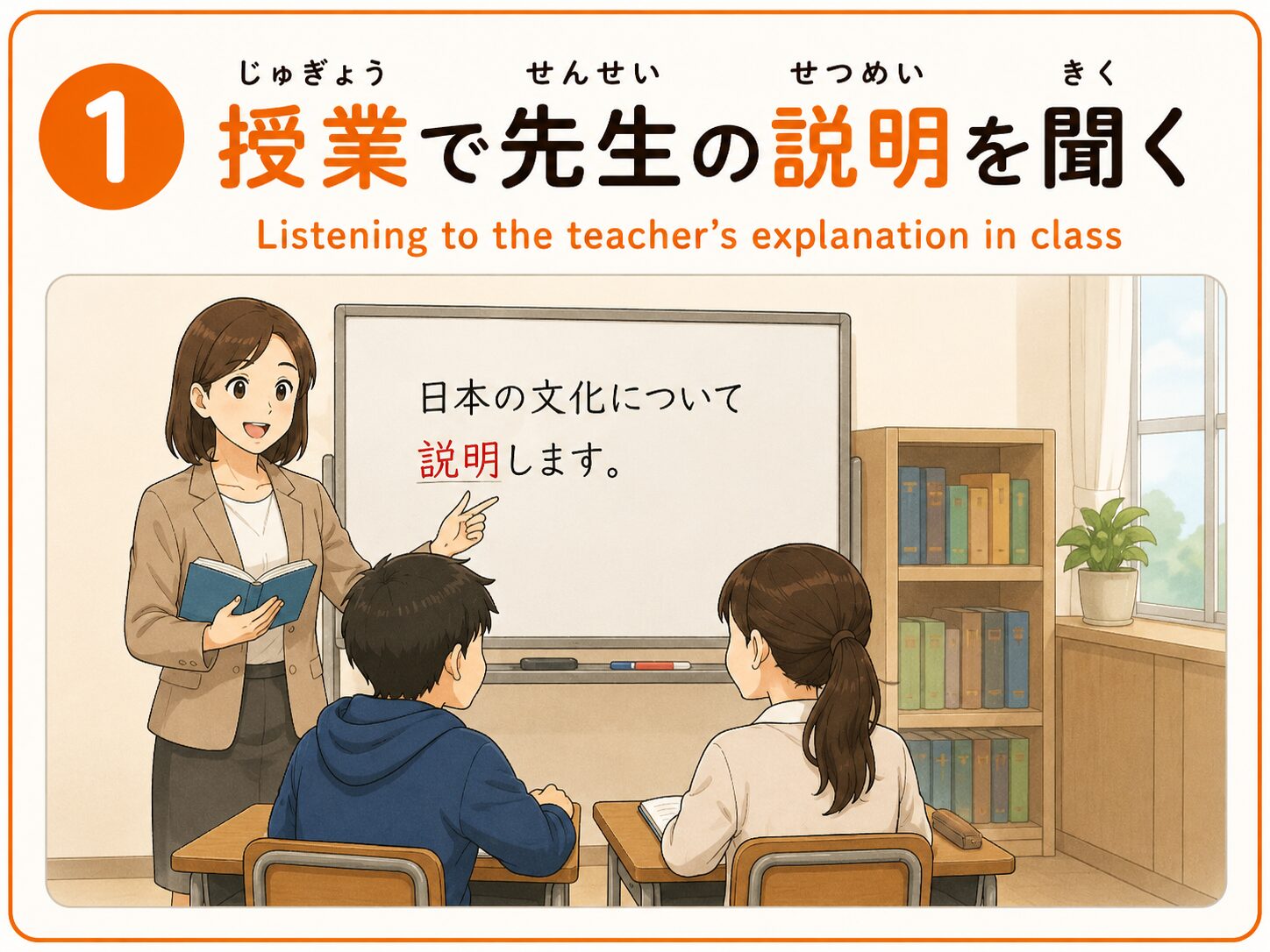
場面① 授業で先生の説明を聞く
Listening to the teacher
クラスで先生の話を聞きます。
この場面では、教・説・明・知・聞 をよく使います。
この場面では、教・説・明・知・聞 をよく使います。
この場面でできるようになること
先生の説明を聞くときのことばを覚えます。
「説明します」「教えてください」「知っていますか」は、学校でも生活でもよく使います。
先生の説明を聞くときのことばを覚えます。
「説明します」「教えてください」「知っていますか」は、学校でも生活でもよく使います。
この場面で使うことば
教える|おしえる
Romaji:oshieruEnglish:to teach
説明|せつめい
Romaji:setsumeiEnglish:explanation
明るい|あかるい
Romaji:akaruiEnglish:bright
知る|しる
Romaji:shiruEnglish:to know
先生の説明|せんせいのせつめい
Romaji:sensei no setsumeiEnglish:teacher’s explanation
教科書を見る|きょうかしょをみる
Romaji:kyoukasho o miruEnglish:to look at the textbook
会話で見てみよう
先生:
今日は、N4の漢字について説明します。
Romaji:Kyou wa, N4 no kanji ni tsuite setsumei shimasu.English:Today, I will explain N4 kanji.
学生:
はい。ノートを見ながら聞きます。
Romaji:Hai. Nooto o minagara kikimasu.English:Yes. I will listen while looking at my notebook.
学生:
すみません。もう一度教えてください。
Romaji:Sumimasen. Mou ichido oshiete kudasai.English:Excuse me. Please teach me one more time.
まねして言う文
先生の説明を聞きます。
Romaji:Sensei no setsumei o kikimasu.English:I listen to the teacher’s explanation.
もう一度教えてください。
Romaji:Mou ichido oshiete kudasai.English:Please teach me one more time.
この漢字を知っていますか。
Romaji:Kono kanji o shitte imasu ka.English:Do you know this kanji?
読む練習
先生がN4の漢字を説明します。学生はノートを見ながら聞きます。わからないときは、もう一度聞きます。
Romaji:Sensei ga N4 no kanji o setsumei shimasu. Gakusei wa nooto o minagara kikimasu. Wakaranai toki wa, mou ichido kikimasu.English:The teacher explains N4 kanji. The student listens while looking at the notebook. When the student does not understand, they ask one more time.
場面② ノートに文字を書く
Writing characters
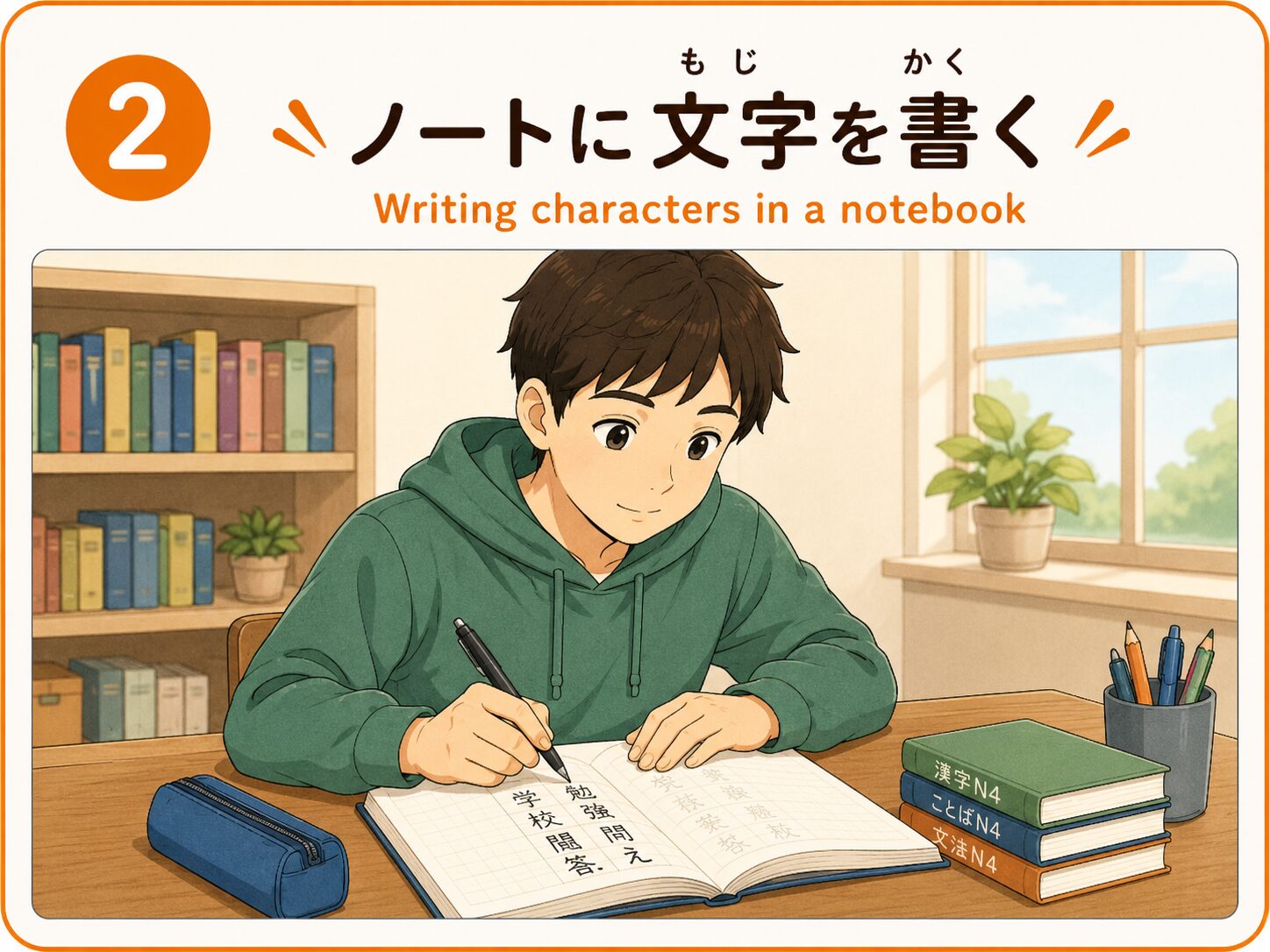
ノートに漢字や文を書きます。
この場面では、文・字・写・習・勉 をよく使います。
この場面では、文・字・写・習・勉 をよく使います。
この場面でできるようになること
漢字や文をノートに書くときのことばを覚えます。
「文字」「文章」「写す」「練習」は、勉強でよく使います。
漢字や文をノートに書くときのことばを覚えます。
「文字」「文章」「写す」「練習」は、勉強でよく使います。
この場面で使うことば
文字|もじ
Romaji:mojiEnglish:character / letter
文|ぶん
Romaji:bunEnglish:sentence
文章|ぶんしょう
Romaji:bunshouEnglish:text / passage
写す|うつす
Romaji:utsusuEnglish:to copy
勉強|べんきょう
Romaji:benkyouEnglish:study
練習|れんしゅう
Romaji:renshuuEnglish:practice
会話で見てみよう
先生:
この文字をノートに書いてください。
Romaji:Kono moji o nooto ni kaite kudasai.English:Please write this character in your notebook.
学生:
はい。ゆっくり写します。
Romaji:Hai. Yukkuri utsushimasu.English:Yes. I will copy it slowly.
先生:
何回も書いて練習しましょう。
Romaji:Nankai mo kaite renshuu shimashou.English:Let’s write it many times and practice.
まねして言う文
ノートに文字を書きます。
Romaji:Nooto ni moji o kakimasu.English:I write characters in my notebook.
この文を写します。
Romaji:Kono bun o utsushimasu.English:I copy this sentence.
毎日、漢字を練習します。
Romaji:Mainichi, kanji o renshuu shimasu.English:I practice kanji every day.
読む練習
学生はノートに文字を書きます。先生の文を写します。漢字を何回も書いて練習します。
Romaji:Gakusei wa nooto ni moji o kakimasu. Sensei no bun o utsushimasu. Kanji o nankai mo kaite renshuu shimasu.English:The student writes characters in the notebook. The student copies the teacher’s sentence. The student writes kanji many times and practices.
場面③ 問題を読んで答える
Reading questions and answering
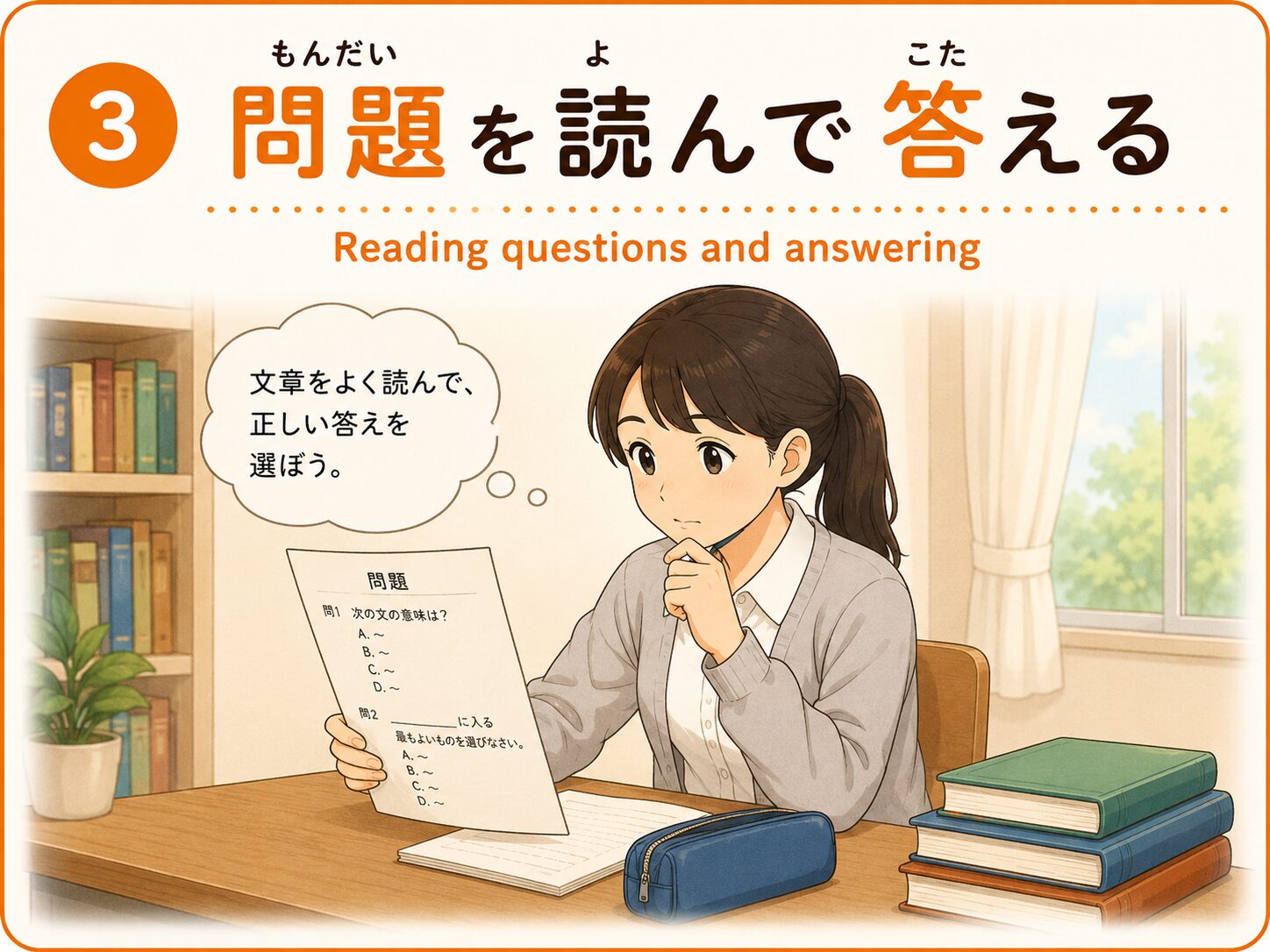
問題を読んで、答えを考えます。
この場面では、問・題・答・考・思 をよく使います。
この場面では、問・題・答・考・思 をよく使います。
この場面でできるようになること
問題を読むとき、答えるときのことばを覚えます。
「問題」「答え」「考える」は、試験や練習問題でよく出ます。
問題を読むとき、答えるときのことばを覚えます。
「問題」「答え」「考える」は、試験や練習問題でよく出ます。
この場面で使うことば
問題|もんだい
Romaji:mondaiEnglish:question / problem
答え|こたえ
Romaji:kotaeEnglish:answer
答える|こたえる
Romaji:kotaeruEnglish:to answer
考える|かんがえる
Romaji:kangaeruEnglish:to think
思う|おもう
Romaji:omouEnglish:to think / feel
正しい答え|ただしいこたえ
Romaji:tadashii kotaeEnglish:correct answer
会話で見てみよう
先生:
問題をよく読んでください。
Romaji:Mondai o yoku yonde kudasai.English:Please read the question carefully.
学生:
はい。答えを考えます。
Romaji:Hai. Kotae o kangaemasu.English:Yes. I will think about the answer.
先生:
わからないときは、もう一度読みましょう。
Romaji:Wakaranai toki wa, mou ichido yomimashou.English:When you do not understand, read it one more time.
まねして言う文
問題をよく読みます。
Romaji:Mondai o yoku yomimasu.English:I read the question carefully.
答えを考えます。
Romaji:Kotae o kangaemasu.English:I think about the answer.
正しい答えを選びます。
Romaji:Tadashii kotae o erabimasu.English:I choose the correct answer.
読む練習
学生は問題を読みます。すぐに答えがわかりません。もう一度読んで、ゆっくり考えます。
Romaji:Gakusei wa mondai o yomimasu. Sugu ni kotae ga wakarimasen. Mou ichido yonde, yukkuri kangaemasu.English:The student reads the question. The student does not know the answer right away. The student reads it again and thinks slowly.
場面④ 試験の前に勉強する
Studying before a test
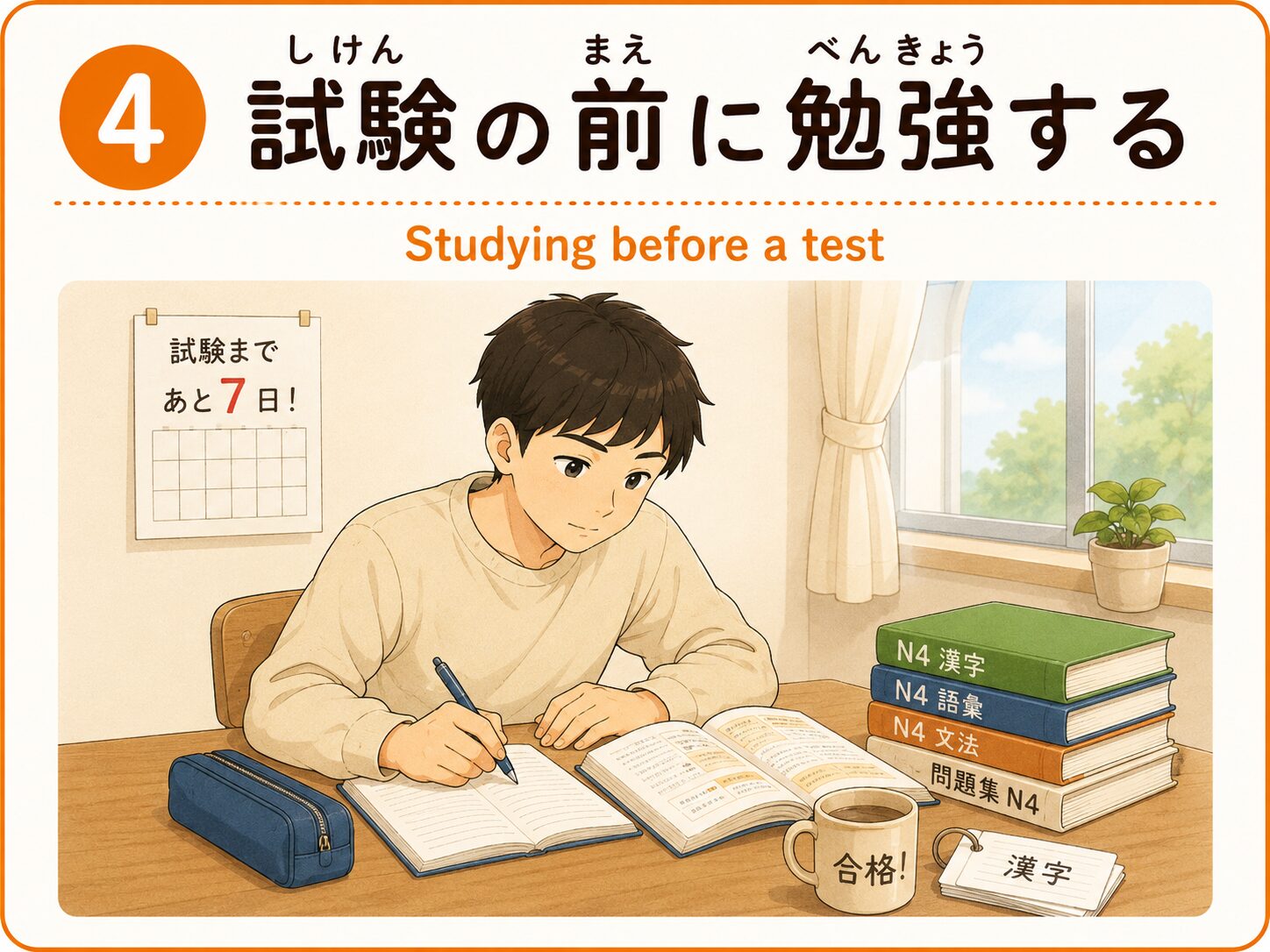
試験の前に、漢字や文法を勉強します。
この場面では、試・験・始・終・研・究 をよく使います。
この場面では、試・験・始・終・研・究 をよく使います。
この場面でできるようになること
試験の前に使うことばを覚えます。
「試験」「始まる」「終わる」「勉強する」は、学校でも試験案内でもよく使います。
試験の前に使うことばを覚えます。
「試験」「始まる」「終わる」「勉強する」は、学校でも試験案内でもよく使います。
この場面で使うことば
試験|しけん
Romaji:shikenEnglish:test / exam
試す|ためす
Romaji:tamesuEnglish:to try
始まる|はじまる
Romaji:hajimaruEnglish:to begin
終わる|おわる
Romaji:owaruEnglish:to finish
研究|けんきゅう
Romaji:kenkyuuEnglish:research / study
勉強する|べんきょうする
Romaji:benkyou suruEnglish:to study
会話で見てみよう
友だち:
試験は何時に始まりますか。
Romaji:Shiken wa nanji ni hajimarimasu ka.English:What time does the test start?
学生:
午前九時に始まります。
Romaji:Gozen ku-ji ni hajimarimasu.English:It starts at 9 a.m.
友だち:
終わったら、いっしょに答えを確認しましょう。
Romaji:Owattara, issho ni kotae o kakunin shimashou.English:After it finishes, let’s check the answers together.
まねして言う文
試験の前に勉強します。
Romaji:Shiken no mae ni benkyou shimasu.English:I study before the test.
試験は九時に始まります。
Romaji:Shiken wa ku-ji ni hajimarimasu.English:The test starts at 9.
試験は十一時に終わります。
Romaji:Shiken wa juuichi-ji ni owarimasu.English:The test finishes at 11.
読む練習
明日は試験です。私は漢字と文法を勉強します。試験は九時に始まって、十一時に終わります。
Romaji:Ashita wa shiken desu. Watashi wa kanji to bunpou o benkyou shimasu. Shiken wa ku-ji ni hajimatte, juuichi-ji ni owarimasu.English:Tomorrow is the test. I study kanji and grammar. The test starts at 9 and finishes at 11.
場面ごとの漢字まとめ
| 場面 | よく使う漢字 | よく使うことば | まねして言う文 |
|---|---|---|---|
| 先生の説明を聞く | 教・説・明・知 | 教える、説明、知る | もう一度教えてください。 |
| ノートに文字を書く | 文・字・写・習・勉 | 文字、文、写す、練習、勉強 | ノートに文字を書きます。 |
| 問題を読んで答える | 問・題・答・考・思 | 問題、答え、考える、思う | 答えを考えます。 |
| 試験の前に勉強する | 試・験・始・終・研・究 | 試験、始まる、終わる、研究 | 試験の前に勉強します。 |
今日のまとめ
今日は、学校・勉強・試験の漢字 を、4つの場面で勉強しました。
今回は、テストではなく、勉強で使う 漢字・ことば・会話・文 を中心にしました。
今日覚えたいこと:
勉強の日本語は、毎日使うと覚えやすいです。
「説明を聞く」「文字を書く」「問題に答える」「試験の前に勉強する」 を声に出して練習しましょう。
勉強の日本語は、毎日使うと覚えやすいです。
「説明を聞く」「文字を書く」「問題に答える」「試験の前に勉強する」 を声に出して練習しましょう。
次に読むおすすめ記事